
Call us now :08045477039
 Send Inquiry
 Send Inquiry
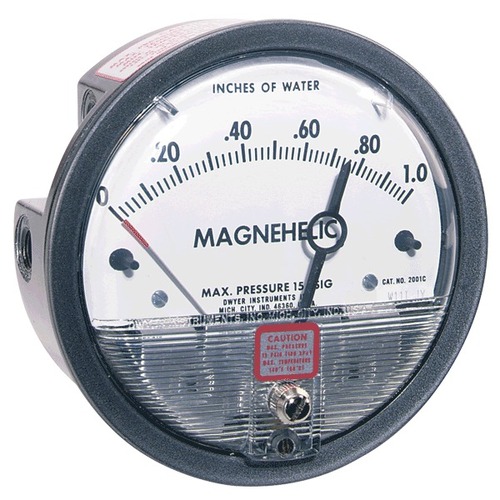
Dwyer Differential Pressure Gauge 0 to 1 KPa
MOQ : 1 Piece
Dwyer Differential Pressure Gauge 0 to 1 KPa Specification
- Product Type
- Pressure Gauge
- Material
- Metal
- Usage
- Display Pressure Difference, Between Two Pressure
- Accuracy
- 2 %
- Weight
- 510-963 Grams (g)
Dwyer Differential Pressure Gauge 0 to 1 KPa Trade Information
- Minimum Order Quantity
- 1 Piece
- Payment Terms
- Cash Advance (CA), Cash in Advance (CID)
- Supply Ability
- 100 Pieces Per Week
- Delivery Time
- 1 Days
- Main Domestic Market
- All India
About Dwyer Differential Pressure Gauge 0 to 1 KPa
Dwyer Magnehelic Differential Pressure Gages,Range: 0-1 KPa
| Service: | Air and non-combustible, compatible gases (natural gas option available). Note: May be used with hydrogen. Order a Buna-N diaphragm. Pressures must be less than 35 psi |
| Wetted Materials: | Consult factor |
| Housing: | Die cast aluminum case and bezel, with acrylic cover. Exterior finish is coated gray to withstand 168 hour salt spray corrosion test |
| Accuracy: | ±2% of FS (±3% on - 0, -100 Pa, -125 Pa, 10MM and ±4% on - 00, -60 Pa, -6MM ranges), throughout range at 70°F (21.1°C) |
| Pressure Limits: | -20 in Hg to 15 psig (-0.677 to 1.034 bar); MP option: 35 psig (2.41 bar); HP option: 80 psig (5.52 bar). |
| Overpressure: | Relief plug opens at approximately 25 psig (1.72 bar), standard gages only. See Overpressure Protection Note on next page |
| Temperature Limits: | 20 to 140°F* (-6.67 to 60°C). -20°F (-28°C) with low temperature option |
| Size: | 4 (101.6 mm) diameter dial face |
| Mounting Orientation: | Diaphragm in vertical position. Consult factory for other position orientations |
| Standard Accessories: | Two 1/8 NPT plugs for duplicate pressure taps, two 1/8 pipe thread to rubber tubing adapter, and three flush mounting adapters with screws. (Mounting and snap ring retainer substituted for three adapters in MP & HP gage accessories.) |
Precision Measurement of Pressure Difference
The Dwyer Differential Pressure Gauge provides accurate measurement of pressure differences up to 1 KPa, making it vital for applications where monitoring subtle variations is crucial. Its 2% accuracy ensures dependable readings, assisting operators in maintaining optimal system performance and preventing issues due to pressure imbalances.
Robust Construction for Diverse Environments
Constructed from high-quality metal, this gauge is engineered for durability and can withstand demanding industrial conditions. Its weight range of 510-963 grams signifies a solid design while retaining portability, suitable for installation in varied environments across India.
Trusted Supply Network Across India
As a product offered by leading distributors, exporters, manufacturers, suppliers, and traders in India, the Dwyer Differential Pressure Gauge is readily available and supported by professional networks ensuring timely delivery and after-sales service for local and export requirements.
FAQ's of Dwyer Differential Pressure Gauge 0 to 1 KPa:
Q: How is the Dwyer Differential Pressure Gauge used to measure pressure difference between two points?
A: The gauge is connected to two points within a system where pressure needs to be monitored. It then accurately displays the pressure difference between these points, allowing for precise control and system diagnostics.Q: What materials are used in the construction of this pressure gauge?
A: This Dwyer pressure gauge is made from robust metal, ensuring durability and longevity even in challenging industrial environments.Q: When should I consider using this differential pressure gauge in my operations?
A: You should use the Dwyer Differential Pressure Gauge whenever you need to monitor and control the pressure difference between two points, especially in applications requiring accurate measurement within the 0 to 1 KPa range.Q: Where is this gauge typically installed within a pressure system?
A: The gauge is typically installed at two points where pressure difference needs to be tracked-such as across filters, pumps, or pipelines-to provide a direct and clear indication of system performance.Q: What is the typical process for installing and calibrating this pressure gauge?
A: Installation involves securing the gauge to the designated points and ensuring airtight connections. Periodic calibration is recommended to maintain the 2% accuracy, often performed using a reference standard or as per manufacturer instructions.Q: What are the primary benefits of using the Dwyer Differential Pressure Gauge?
A: Key benefits include precise pressure monitoring, enhanced operational safety, early detection of anomalies, and reduced downtime through performance optimization and preventive maintenance.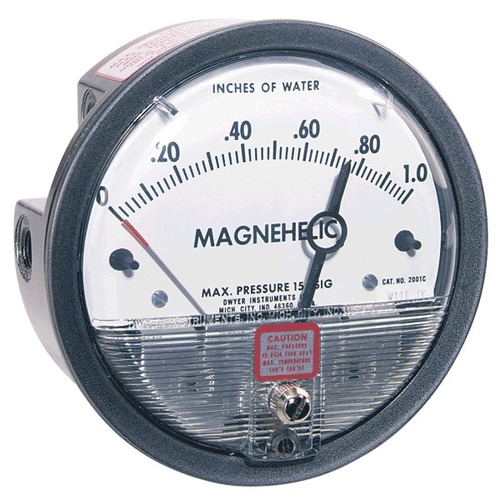
Tell us about your requirement

Price:
Quantity
Select Unit
- 50
- 100
- 200
- 250
- 500
- 1000+
Additional detail
Mobile number
Email

More Products in Dwyer HVAC Sensors Category
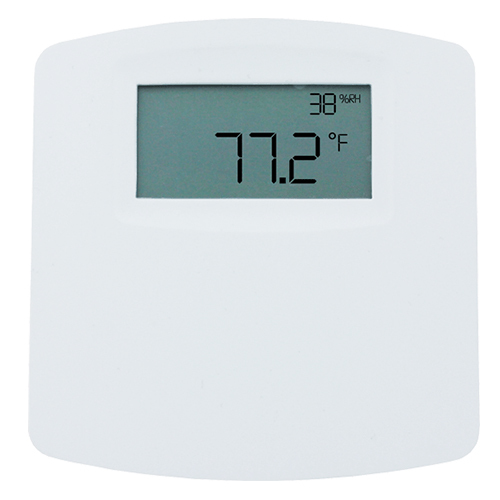
Room Humidity/Temperature Sensor
Price 10700 INR / Piece
Minimum Order Quantity : 1 , , Piece
Product Type : Humidity Sensor
Weight : Approx. 120g
Material : Plastic
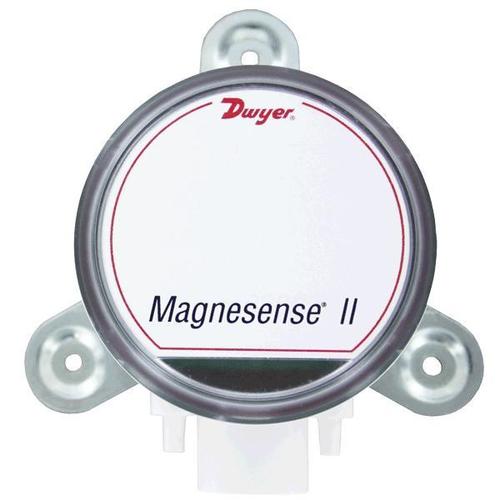
Dwyer Differential Pressure Transmitter MS2-W103
Price 7500 INR / Piece
Minimum Order Quantity : 1 , , Piece
Product Type : Pressure Transmitter
Weight : 110 g
Material : Plastic
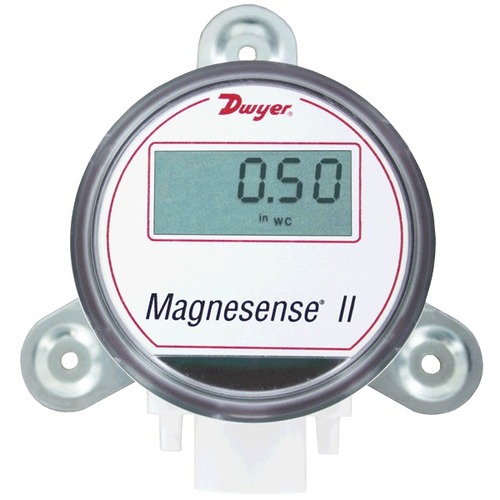
Dwyer Differential Pressure Transmitter MS2-W102
Price Range 4000.00 - 10000.00 INR / Piece
Minimum Order Quantity : 1 , , Piece
Product Type : Pressure Transmitter
Weight : Approx. 150 g
Material : Plastic
Dwyer Differential Pressure Gauge 0 to 200 mm
Price Range 5000.00 - 7700.00 INR
Minimum Order Quantity : 1 Piece
Product Type : Pressure Gauge
Weight : 510963 Grams (g)
Material : Metal


 Send Inquiry


Our Products
- Honeywell Gas Burner Controls
- Honeywell HVAC Controls
- Honeywell Paperless Recorders
- Honeywell Limit Switches
- Baumer Pressure & Temp Gauges
- Dwyer HVAC Sensors
- Honeywell Micro Switches
- Honeywell PID Controllers
- Honeywell Sensor IC Chips
- Greystone HVAC Sensors
- Thermodynamic Steam Traps
- Kavlico Pressure Transmitters
- City Technology Gas Sensors
- Honeywell Thermostat Switches
- Secure Energy Meter
- Honeywell Water Meter
- Honeywell Oil Flow Meter
- Honeywell Pressure Transmitter
- Honeywell Barcode Scanner
- Honeywell Safety Products
- Honeywell RFID System
- Honeywell Mobile Computer
- Honeywell Barcode Printer
- Honeywell Particle Sensor
- IP Converter
- Pneumatic Positioner
- Proximity Sensor
- Rotary Encoder
- Programmable PID Controllers
- Switch Mode Power Supply
- ABB Electromagnetic Products
- City Technology Sensors
- Secure Bi-Directional Meters
- Autonics Products
- Electromagnetic Flow Meter
- Fiber Optic Cable
- Optical Amplifiers
- Modular Tower Light
- Piezo Buzzer
- Photoelectric Sensors
- Digital Counters
- Hybrid Recorder
- Digital Paperless Recorder
- Vision Sensors
- Piston Valves
- Honeywell Torque Sensor
- IOT Gateway and IOT Devices
- Dew Point Sensors
- Thermal Transfer Ribbon
- Temperature Sensors
- Level Switch


232, Sunrise Mall, Near Swaminarayan Mandir, Judges Bungalow Road, Vastrapur, Ahmedabad - 380015, Gujarat, India

Mr Rajesh Garg
(CEO)
Mobile :08045477039
 Send Inquiry
 Send SMS
 Call Me Free
Developed and Managed by Infocom Network Private Limited.


 English
 Spanish
 French
 German
 Italian
 Chinese (Simplified)
 Japanese
 Korean
 Arabic
 Portuguese