
Call us now :08045477039
 Send Inquiry
 Send Inquiry
Honeywell PID Controller DC1030
MOQ : 1 Piece
Honeywell PID Controller DC1030 Specification
- Voltage
- 240 Volt (v)
- Power
- 8 VA maximum
- Display
- Dual 4-digit seven segment LED
- Usage
- Process Control
- Product Type
- PID Controller
- Material
- ABS plastic enclosure
- Design
- Compact DIN 1/16 size
- Power Source
- Electric
- Accuracy
- 0.5% of span
- Illuminant
- LED Display
- Dimension (L*W*H)
- 48 mm x 48 mm x 95 mm
- Weight
- 500 Grams (g)
- Input Type
- Thermocouple, RTD (Pt100), Voltage or Current
- Control Output
- Relay, Voltage Pulse, or Current (selectable)
- Control Algorithm
- PID, ON/OFF, Manual
- Operating Temperature
- 0C to 50C
- Alarm Output
- Optional, configurable
- Mounting
- Panel Mount
- Set Point
- Single set point
- Communications
- RS485 (optional)
- Sampling Cycle
- 250 ms
- Front Panel Protection
- IP65
Honeywell PID Controller DC1030 Trade Information
- Minimum Order Quantity
- 1 Piece
- Payment Terms
- Cash in Advance (CID), Cash Advance (CA)
- Supply Ability
- 100 Pieces Per Week
- Delivery Time
- 1 Week
- Main Domestic Market
- All India
About Honeywell PID Controller DC1030
Honeywell PID DC1030 Controller
| Specification |
|
|
| Honeywell Low cost PID controller |
| Four Different Model DC1010, DC1020, DC1030, DC1040 |
| Available in four different sizes: 1/16 DIN, 1/8 DIN, 3/16 DIN, 1/4 DIN |
| Set point programming |
| Two large 4 digits displays and one 10 LED bargraph display PV, SP and |
| Setpoint Programming |
| Extended Alarm capability |
Versatile Control Options
The Honeywell PID Controller DC1030 provides flexibility with selectable relay, voltage pulse, or current control output, making it suitable for various industrial processes. Its compatibility with thermocouple, RTD, voltage, and current inputs further extends its application range in temperature and process management.
User-Friendly Design and Interface
Designed with a compact DIN 1/16 size for easy panel mounting, the DC1030 features a front panel with IP65 protection. The dual 4-digit seven-segment LED display ensures clear visibility of set values and process readings, simplifying monitoring and adjustments for users.
Reliable and Accurate Performance
The DC1030 offers high accuracy of 0.5% of span and a fast 250 ms sampling cycle. Its robust ABS plastic enclosure and wide operating temperature range (0C to 50C) ensure reliable performance in demanding environments, making it a dependable choice for industrial applications.
FAQ's of Honeywell PID Controller DC1030:
Q: How can I use the Honeywell PID Controller DC1030 for process control applications?
A: You can use the DC1030 to regulate temperature or other process variables by connecting appropriate input sensors (thermocouple, RTD, voltage, or current) and configuring the control output (relay, voltage pulse, or current) to interface with your control element (such as heaters or actuators). Its PID, ON/OFF, or manual control algorithms allow for tailored process response.Q: What are the benefits of its selectable control outputs?
A: The selectable relay, voltage pulse, or current outputs provide flexibility to match various types of actuators and control elements in your process system. This adaptability increases installation options and integration capability across multiple applications.Q: When should I configure the optional alarm output?
A: Configure the optional alarm output to trigger alerts or safety shutdowns when process variables exceed or drop below specified thresholds. This is beneficial for maintaining safety and minimizing downtime in critical applications.Q: Where can I install the Honeywell DC1030 controller?
A: The DC1030 is designed for panel mounting, making it suitable for installation in industrial control panels, machinery enclosures, or process control rooms. Its compact 48 mm x 48 mm size and front-panel IP65 protection allow for easy integration even in challenging environments.Q: What is the process for setting and monitoring the control parameters?
A: Control parameters are set using the front-panel buttons, with set points and feedback clearly displayed on the dual 4-digit LED displays. The controller's fast 250 ms sampling cycle allows for real-time process monitoring and adjustments, ensuring optimal control.Q: How does the optional RS485 communication benefit my process system?
A: The RS485 communication (if equipped) enables remote monitoring, control, and integration with centralized process management systems. This enhances data logging, automation, and centralized supervision, streamlining operations and diagnostics.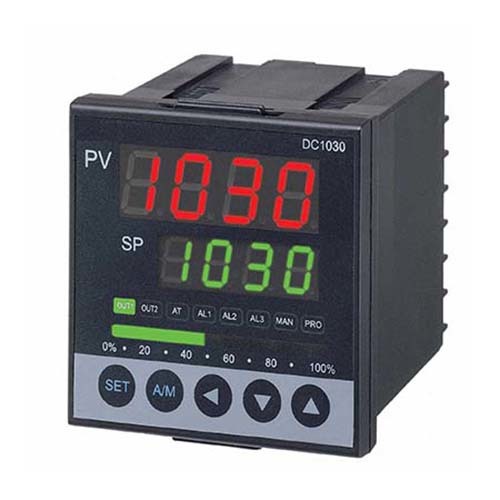
Tell us about your requirement

Price:
Quantity
Select Unit
- 50
- 100
- 200
- 250
- 500
- 1000+
Additional detail
Mobile number
Email

More Products in Honeywell PID Controllers Category
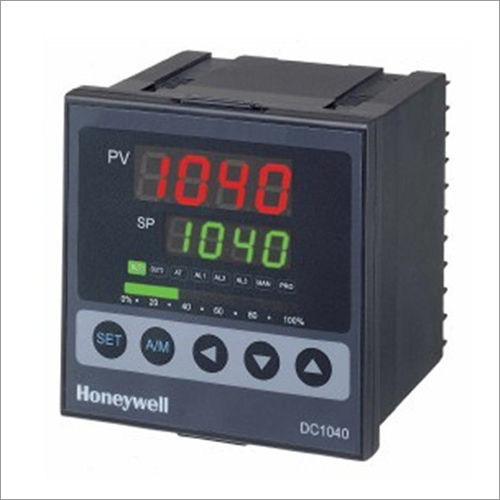
Honeywell PID Controller DC1040
Price 5000 INR / Piece
Minimum Order Quantity : 1 Piece
Illuminant : LED
Design : Panel Mount
Power : 5VA max
Accuracy : 0.5% of full scale
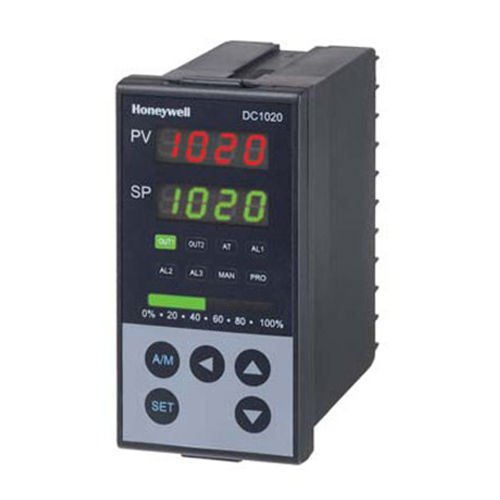
Honeywell PID Controller DC1020
Price 4000 INR / Piece
Minimum Order Quantity : 1 Piece
Illuminant : LED Display
Design : Panel Mount
Power : 5 VA Max
Accuracy : 0.5% FS 1 digit
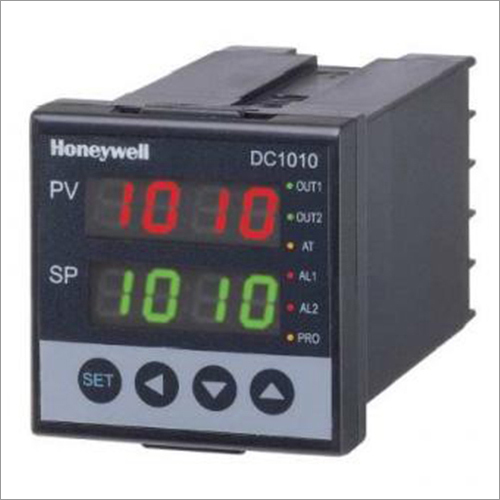
Honeywell PID Controller DC1010
Minimum Order Quantity : 1 Piece
Illuminant : LED
Design : Compact DIN 1/16 (48x48 mm)
Power : 5 VA (max)
Accuracy : 0.5% of full scale


 Send Inquiry


Our Products
- Honeywell Gas Burner Controls
- Honeywell HVAC Controls
- Honeywell Paperless Recorders
- Honeywell Limit Switches
- Baumer Pressure & Temp Gauges
- Dwyer HVAC Sensors
- Honeywell Micro Switches
- Honeywell PID Controllers
- Honeywell Sensor IC Chips
- Greystone HVAC Sensors
- Thermodynamic Steam Traps
- Kavlico Pressure Transmitters
- City Technology Gas Sensors
- Honeywell Thermostat Switches
- Secure Energy Meter
- Honeywell Water Meter
- Honeywell Oil Flow Meter
- Honeywell Pressure Transmitter
- Honeywell Barcode Scanner
- Honeywell Safety Products
- Honeywell RFID System
- Honeywell Mobile Computer
- Honeywell Barcode Printer
- Honeywell Particle Sensor
- IP Converter
- Pneumatic Positioner
- Proximity Sensor
- Rotary Encoder
- Programmable PID Controllers
- Switch Mode Power Supply
- ABB Electromagnetic Products
- City Technology Sensors
- Secure Bi-Directional Meters
- Autonics Products
- Electromagnetic Flow Meter
- Fiber Optic Cable
- Optical Amplifiers
- Modular Tower Light
- Piezo Buzzer
- Photoelectric Sensors
- Digital Counters
- Hybrid Recorder
- Digital Paperless Recorder
- Vision Sensors
- Piston Valves
- Honeywell Torque Sensor
- IOT Gateway and IOT Devices
- Dew Point Sensors
- Thermal Transfer Ribbon
- Temperature Sensors
- Level Switch


232, Sunrise Mall, Near Swaminarayan Mandir, Judges Bungalow Road, Vastrapur, Ahmedabad - 380015, Gujarat, India

Mr Rajesh Garg
(CEO)
Mobile :08045477039
 Send Inquiry
 Send SMS
Developed and Managed by Infocom Network Private Limited.


 English
 Spanish
 French
 German
 Italian
 Chinese (Simplified)
 Japanese
 Korean
 Arabic
 Portuguese